 Add to Chrome
 Add to Firefox
 Add to Edge
KV-RM: Regularizing KV-Cache Movement for Static-Graph LLM Serving
May 10, 2026
Static-graph LLM decoders provide predictable launches, fixed tensor shapes, and low submission overhead, but online decoding exposes highly irregular KV-cache behavior: request lengths differ, EOS events arrive asynchronously, and logical histories fragment over time. Dynamic runtimes recover flexibility through paged KV management and step-level scheduling, while static-graph executors often over-reserve memory and suffer burst-time latency outliers. This paper studies whether much of this variability can be absorbed below a fixed decode interface. We present KV-RM, a runtime design that regularizes KV-cache movement beneath a static-graph LLM decoder. KV-RM decouples logical KV histories from physical storage, tracks active KV state through a block pager, and materializes each decode step through a single committed descriptor. A merge-staged transport path coalesces non-contiguous KV mappings into a small number of large transfer groups before a fixed-shape attention kernel consumes them. Optional bounded far-history summaries can be enabled under the same interface, but the core design does not depend on them. On a 2-GPU NVIDIA A100 node, KV-RM improves mixed-length decoding throughput and tail latency relative to a static-graph baseline, reduces reserved KV memory across workload families, and removes severe burst-time latency spikes under production-trace replay. These results suggest that KV-cache movement, rather than kernel shape, can be an effective boundary for recovering runtime flexibility in static-graph LLM serving.

An Efficient Gradient-Aware Error-Bounded Lossy Compressor for Federated Learning
Nov 07, 2025Federated learning (FL) enables collaborative model training without exposing clients' private data, but its deployment is often constrained by the communication cost of transmitting gradients between clients and the central server, especially under system heterogeneity where low-bandwidth clients bottleneck overall performance. Lossy compression of gradient data can mitigate this overhead, and error-bounded lossy compression (EBLC) is particularly appealing for its fine-grained utility-compression tradeoff. However, existing EBLC methods (e.g., SZ), originally designed for smooth scientific data with strong spatial locality, rely on generic predictors such as Lorenzo and interpolation for entropy reduction to improve compression ratio. Gradient tensors, in contrast, exhibit low smoothness and weak spatial correlation, rendering these predictors ineffective and leading to poor compression ratios. To address this limitation, we propose an EBLC framework tailored for FL gradient data to achieve high compression ratios while preserving model accuracy. The core of it is an innovative prediction mechanism that exploits temporal correlations across FL training rounds and structural regularities within convolutional kernels to reduce residual entropy. The predictor is compatible with standard quantizers and entropy coders and comprises (1) a cross-round magnitude predictor based on a normalized exponential moving average, and (2) a sign predictor that leverages gradient oscillation and kernel-level sign consistency. Experiments show that this new EBLC yields up to 1.53x higher compression ratios than SZ3 with lower accuracy loss. Integrated into a real-world FL framework, APPFL, it reduces end-to-end communication time by 76.1%-96.2% under various constrained-bandwidth scenarios, demonstrating strong scalability for real-world FL deployments.
Bi-Grid Reconstruction for Image Anomaly Detection
Apr 01, 2025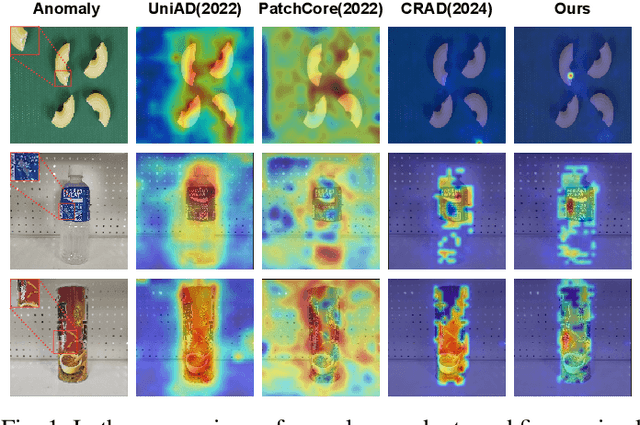
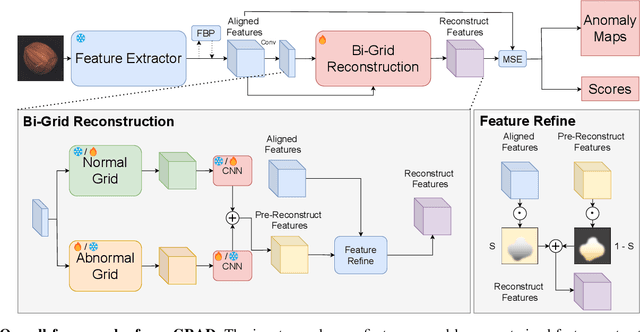
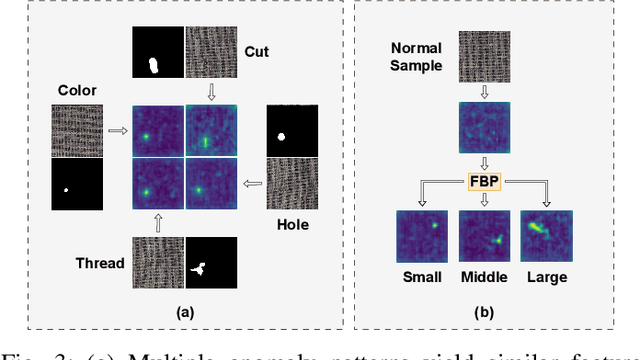
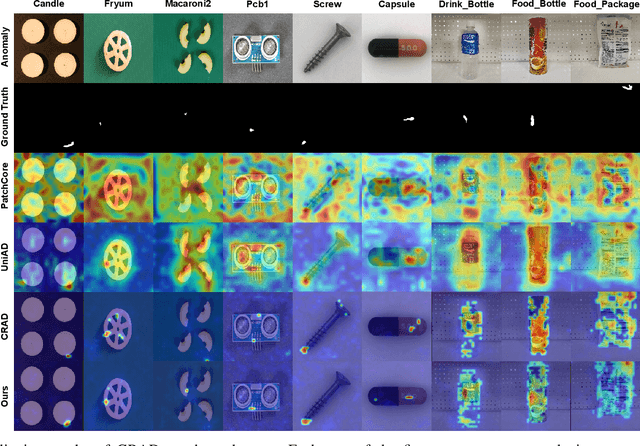
In image anomaly detection, significant advancements have been made using un- and self-supervised methods with datasets containing only normal samples. However, these approaches often struggle with fine-grained anomalies. This paper introduces \textbf{GRAD}: Bi-\textbf{G}rid \textbf{R}econstruction for Image \textbf{A}nomaly \textbf{D}etection, which employs two continuous grids to enhance anomaly detection from both normal and abnormal perspectives. In this work: 1) Grids as feature repositories that improve generalization and mitigate the Identical Shortcut (IS) issue; 2) An abnormal feature grid that refines normal feature boundaries, boosting detection of fine-grained defects; 3) The Feature Block Paste (FBP) module, which synthesizes various anomalies at the feature level for quick abnormal grid deployment. GRAD's robust representation capabilities also allow it to handle multiple classes with a single model. Evaluations on datasets like MVTecAD, VisA, and GoodsAD show significant performance improvements in fine-grained anomaly detection. GRAD excels in overall accuracy and in discerning subtle differences, demonstrating its superiority over existing methods.
Technology Report:Multi-Mobile Robot Localization and Navigation based on Visible Light Positioning
Nov 18, 2021We demonstrated multi-mobile robot navigation based on Visible Light Positioning(VLP) localization. From our experiment, the VLP can accurately locate robots' positions in navigation.